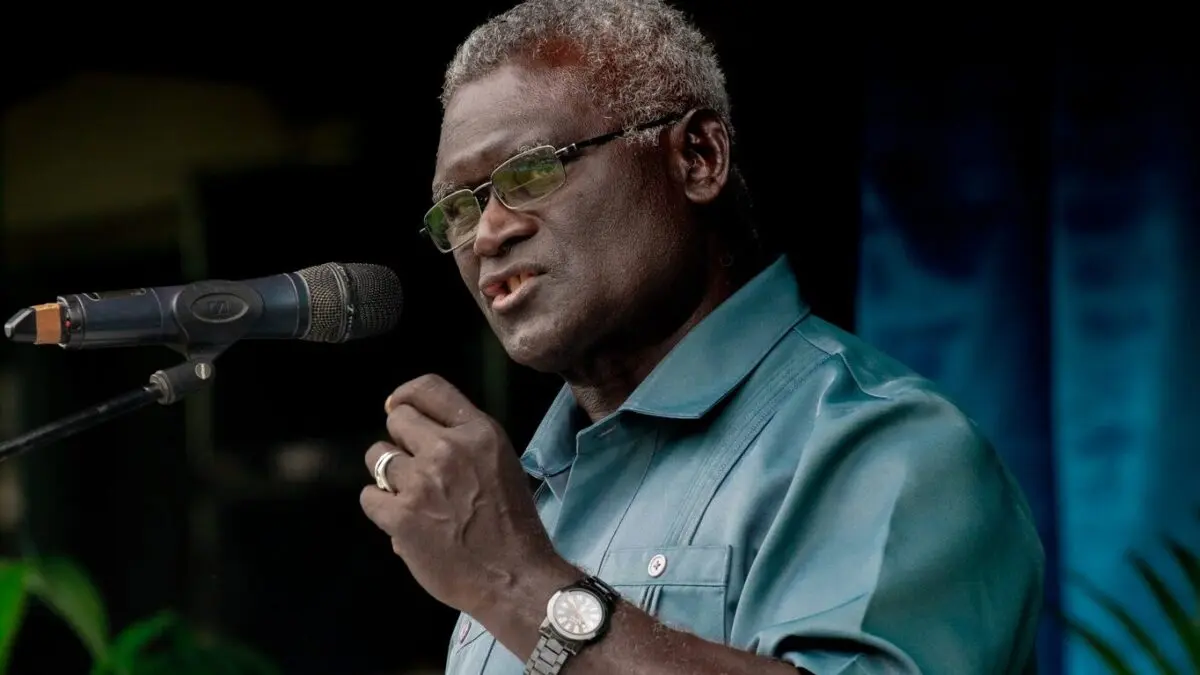
Leader of the Official Opposition Manasseh Sogavare wants the Australia-Solomon Islands Treaty tabled and fully debated in Parliament before the two governments exchange the diplomatic notes that bring it into force.
Prime Minister Matthew Cooper Wale and Australian Prime Minister Anthony Albanese signed the treaty in Canberra on 25 November (our report). Sogavare, the Member of Parliament for East Choiseul, said it is a legally binding agreement with no end date that seeks to bind every future government.
He said Solomon Islands values its long friendship with Australia and that the issue was not Australia. "It is about whether a decision this big, which limits who our country may work with on security for years to come, should be made by Cabinet alone. It should not," Sogavare said.
The Opposition said the treaty's firmest obligations fall on Solomon Islands. Under Article 5, it said, Solomon Islands must ensure its security cooperation comes from Pacific Islands Forum members and may turn to others only for needs Forum members cannot meet. Sogavare said the treaty does not say who decides that.
He said the limit applies to every partner outside the Forum, including some of the country's oldest friends. The same article keeps ports, airports, energy, digital and telecommunications infrastructure free from foreign interference and unauthorised access, terms the Opposition said are not defined.
Sogavare said Australia gives no defence guarantee in return. The treaty names Australia as Solomon Islands' primary security partner, including to support its security needs where both parties agree.
On money, he said no dollar amount appears in the treaty and the funding is left to a financing plan that has not been negotiated or published. Article 10 says the two governments will jointly develop a financing and implementation plan.
If a dispute is not settled within six months, either side may suspend one or more of its obligations. Sogavare said that because Australia's main obligations are funding, its support could be suspended while Solomon Islands' security commitments would remain.
Disputes cannot go to any court, tribunal or other third party, and under Article 9 that bar stays binding after the treaty ends unless both sides agree otherwise in writing. Either government may give notice to end the treaty, but the termination takes effect on a date the two agree, after their national processes are complete.
Sogavare said the government has told Beijing it will not renew the 2022 security cooperation arrangement with China, but has yet to explain to Parliament the assessment behind that decision or what will replace the training, equipment and support the Royal Solomon Islands Police Force has received.
Asked in Canberra about the 2022 agreement, Wale said the security and policing agreements with China contain a non-disclosure clause, so he could not discuss them, and that discussions with China are ongoing.
Besides tabling the treaty with a national interest statement, the Opposition asked the government to publish the financing and implementation plan, with the amounts, the timeframe and how much is new money rather than existing aid under a new name.
It also asked for a guarantee that budget support will not go into Constituency Development Funds, with the Auditor-General reporting on its use, a list of every security and infrastructure arrangement affected by Article 5, and a yearly report to Parliament on the treaty and the Iumi Committee.
Wale told reporters in Canberra that his government would put legislation before Parliament in January or February, after the budget. The treaty takes effect only when both governments have notified each other by diplomatic notes that their own requirements are complete.
The Opposition said it would scrutinise the treaty line by line.