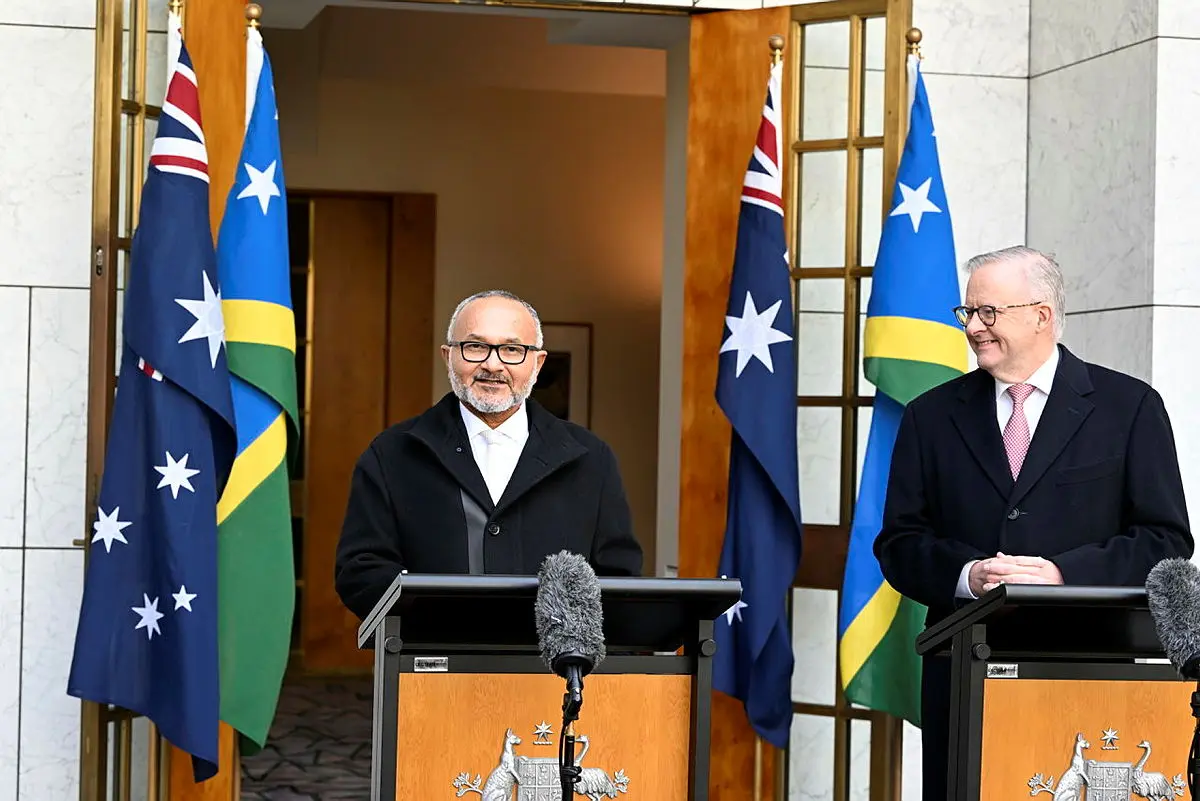
Prime Minister Matthew Cooper Wale and Australian Prime Minister Anthony Albanese signed the Australia-Solomon Islands Treaty in Canberra on 25 November. Under it, Solomon Islands commits not to allow any foreign military or security base on its territory, and Australia promises budget support, more seasonal work and easier visas for Solomon Islanders.
The treaty is not yet in force. Wale told reporters at Parliament House that his government would put legislation before Parliament in January or February, after the budget, to bed the treaty down. It takes effect when both governments have confirmed to each other, by an exchange of diplomatic notes, that their own requirements are complete.
Wale, who travelled with 17 members of his cabinet according to Albanese, said the treaty resets the relationship and makes Solomon Islands a trusted partner in the region. "Solomon Islands has been for a number of years a source of uncertainty and doubt in the region. Those days are done," he said.
What Solomon Islanders are promised
The two governments said in a joint statement that the treaty includes substantial support for the government's free education policy. Australia will also provide budget support and increase its investment in infrastructure such as roads and renewable energy, the statement said.
The treaty text goes further on money. Under Article 4, Australia shall support Solomon Islands to set up a sovereign wealth fund and contribute to its capital, and shall provide budget support. In return, Solomon Islands shall ensure integrity, transparency and accountability in how it manages public money. The article also names roads, maritime infrastructure and bridges as shared priorities.
None of the three documents gives a dollar figure. Article 10 says the two governments will jointly develop a financing and implementation plan, with short-term support and long-term budget allocations.
On jobs, Australia will support a "PALM Plus" approach to raise Solomon Islands' share of the Pacific Australia Labour Mobility scheme, the statement said, including new openings in early childhood and aged care, access to new locations and more skills training. The treaty also commits both sides to strengthen technical and vocational training in Solomon Islands for the local labour market as well as for work abroad.
Solomon Islanders travelling to Australia are to get longer stays, visas valid for longer and visa services in Honiara. Albanese said Australia would open a new visa office in the capital. He also said the football partnership would expand, including support for the Solomon Kings Football Club.
Security: no foreign base, the Forum first
The security commitments are in Article 5. Solomon Islands shall keep its sensitive infrastructure free from militarisation, any form of foreign interference or unauthorised access. The treaty defines that infrastructure as airports, ports, energy, digital and telecommunications infrastructure.
Solomon Islands shall also not allow its territory to be used for any foreign military or security base, which the treaty defines as a facility under the control of a foreign government or entity. It shall ensure that security cooperation comes from Pacific Islands Forum members, and when it turns to a country outside the Forum for needs Forum members cannot meet, it shall safeguard the security of both countries and the region.
The two governments shall deepen dialogue on security and sensitive infrastructure "on the basis of sovereign equality, shared interests, and prior consultation", the treaty says. Albanese told reporters this meant commitments to prior consultation on critical infrastructure and on Solomon Islands' security cooperation with countries outside the Forum.
The treaty names Australia as Solomon Islands' primary security partner. It commits both sides to a long-term police partnership, led by Solomon Islands and supported by Australia, for a stronger and self-reliant Royal Solomon Islands Police Force, and to more intelligence sharing. The joint statement said the treaty affirms Solomon Islands' sovereignty and its right to decide its own security needs and partners.
The China question
Asked about the status of the 2022 security agreement with China and whether Solomon Islands had discussed ending it, Wale said the security pact and the policing agreement with China contain a non-disclosure clause, so he could not talk about them. He said there are ongoing discussions with China, but the day was about the relationship with Australia.
Albanese did not say whether Australia had asked Solomon Islands to end the China agreement. He said the treaty would be released in full and that security in the Pacific is the responsibility of the Pacific family.
How it will work
An Iumi Committee, chaired by the two foreign ministers or senior officials, will oversee the treaty. It must meet at least once a year, and within two weeks whenever either side asks, and it decides by consensus. Traditional, faith, business or community leaders may be invited to join it from time to time.
Disputes over the treaty cannot go to any court or tribunal. They are to be settled by talks within six months; if that fails, either side may suspend one or more of its obligations. Either government may end the treaty by written notice, which takes effect after each country's own processes are complete.
At home
Wale said the decision to sign was taken unanimously by his caucus and his whole cabinet. Asked about the motion of no confidence against him that was withdrawn earlier in 2026, and whether the treaty would outlast him, he said he would welcome another such motion and looked forward to it.
Wale is expected back in Honiara on Friday, 27 November, the Government Communication Unit said on 24 November when he left for Canberra.
On 24 November, Leader of the Official Opposition Manasseh Sogavare questioned the size and cost of the delegation to Canberra, which he put at 24 people. He also asked how the new treaty differs from the bilateral security treaty Solomon Islands and Australia signed in August 2017, and why it was being fast-tracked while the future of the security arrangement with China remained unclear (our report).
The treaty is one of several Australia has signed in the region. Albanese said Australia had signed agreements with Papua New Guinea, Vanuatu and Fiji, and that the treaties with Vanuatu and Fiji were coming into force that same week.
Sources: joint statement and press conference transcript, Prime Minister of Australia, 25 November 2026; treaty text, Department of Foreign Affairs and Trade (CC BY 4.0). Links shared by the Australian High Commission in Honiara.