Pacific leaders and scholars have called for faster climate action, stronger access to climate finance and greater recognition of the realities facing Small Island Developing States as pre-COP31 began in Fiji on 5 October.
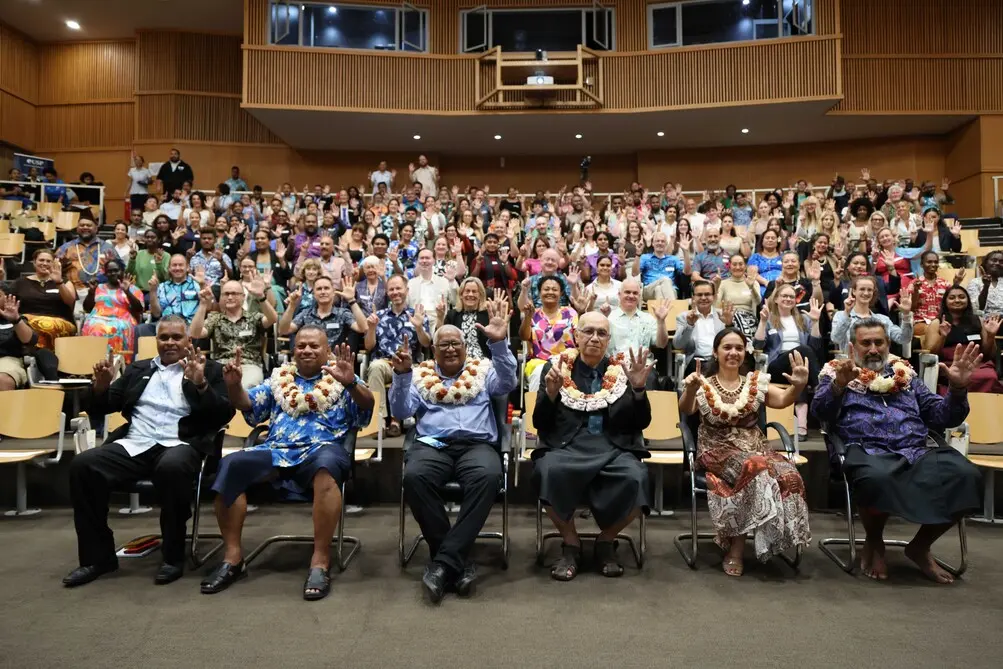
The calls came out of a regional lead-in discussion at The University of the South Pacific (USP) Laucala Campus in Suva on Saturday 3 October, hosted by USP with the COP Universities Alliance under the banner "1.5C to Stay Alive: Aligning Finance, Justice and Community Voices to Keep 1.5C in Reach".
The meeting brought together Pacific and Australian scholars, policymakers and climate advocates to look at ways to keep 1.5C within reach, strengthen international legal obligations, expand climate finance and respond to ocean warming and sea-level rise, the university said.
According to the release, speakers said international action since the Paris Agreement had shifted the projected global warming path from about 4.0C to about 2.6C, but that this was not enough. Holding warming to 1.5C would need a much faster pace of decarbonisation, climate finance and international cooperation, they said.
USP Pro-Chancellor and Chair of Council and the Interim Management Group, Siosiua Utoikamanu, said the consequences of going past 1.5C could not be judged by global statistics alone.
"For the Pacific, 1.5C is not an abstract point on a chart. It concerns whether coastal communities can remain where they are, whether families have reliable water and food, whether the ocean can continue to sustain livelihoods, and what choices will be available to the next generation," Utoikamanu said.
He said the prospect of temporarily passing the threshold could not be treated as a harmless delay followed by an easy return, because for a community facing saltwater intrusion or the loss of a reef, a temporary global overshoot could leave lasting local damage.
Utoikamanu said USP had a responsibility to contribute to the regional and global climate discussion, as a university created and owned by Pacific countries. Its staff studied oceans and sea-level rise, climate risks and adaptation, finance and public policy, and trained the scientists, lawyers, public servants and negotiators who would carry the work forward, he said.
COP31 Envoy for Oceania Kristina Eonemto Stege said the Pacific had been sounding the alarm for decades and that the region's role was to stay awake as a sentinel, or juumemmej, from the frontlines. Pre-COP had brought leaders, officials and party delegations from around the world to the Pacific, she said, and for the region "1.5 to stay alive" was a lifeline rather than a slogan.
UNSW Institute for Climate Risks and Response Research Associate Dr Wesley Morgan, speaking for the COP Universities Alliance, said the conference was a partnership between universities in Australia and across the Pacific, and that it brought together knowledge in science, law, social science and the arts.
USP said discussions during the week in Fiji would focus on four priorities: keeping 1.5C within reach, improving access to climate finance, raising the ocean-climate link, and amplifying Pacific leadership and youth voices.