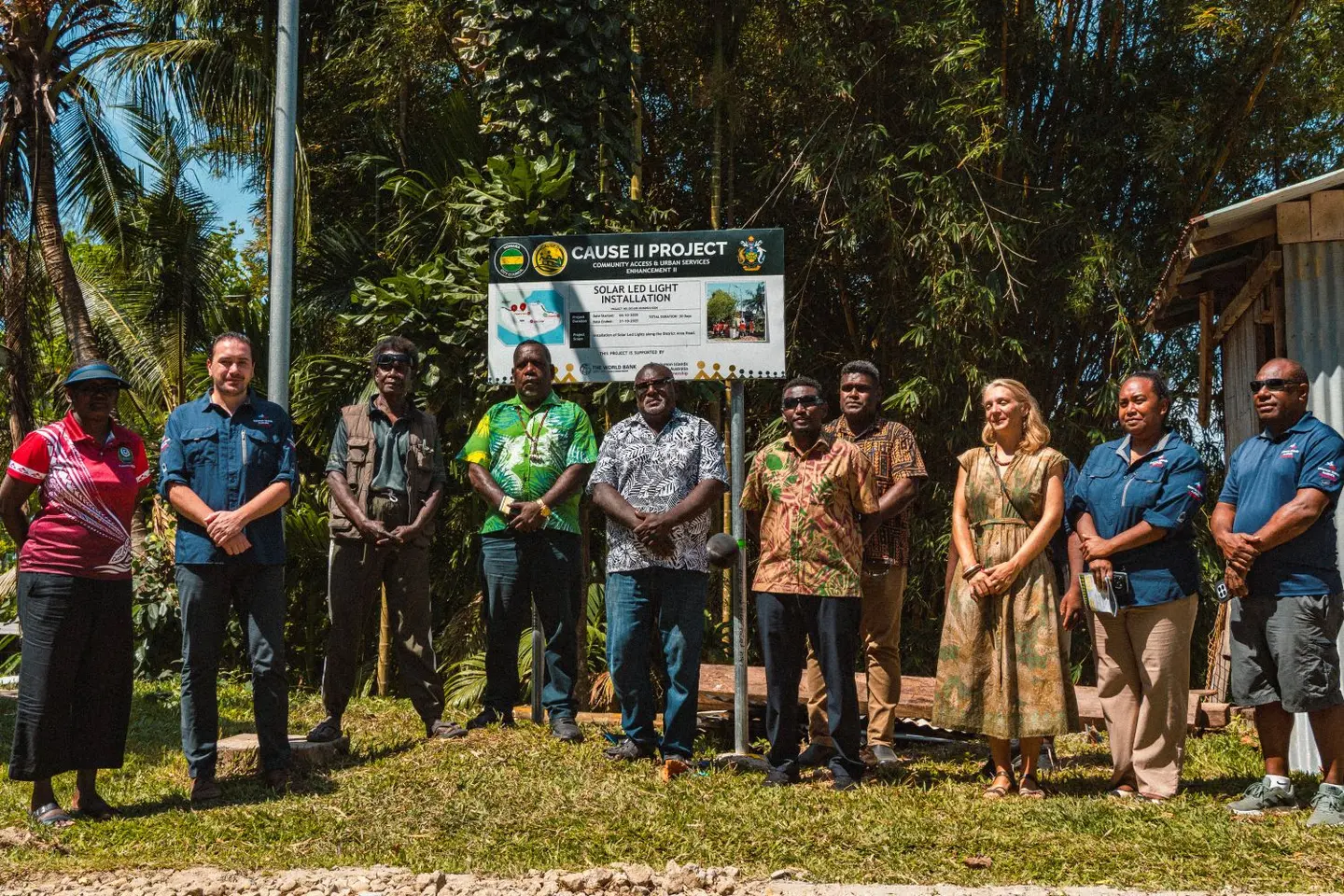
Australia has handed over 19 community infrastructure projects in Gizo and Noro under phase two of the Community Access and Urban Services Enhancement Project (CAUSE II).
The projects include solar LED lights, footpaths, a Jacob's Ladder, a lower landing deck and upgrades to Noro market facilities.
The Australian High Commission said the projects are improving access to safer, more climate-resilient infrastructure and services, while creating local employment and skills development opportunities, with a particular focus on women and young people.
Representatives of the High Commission joined Western Provincial Government Minister of Works Hon Freedom Tozaka, Member for Gizo and Kolombangara Hon Jimson Tanangada, the World Bank and government officials to mark the handover.
Tozaka acknowledged the support of Australia and the World Bank in delivering the projects through CAUSE II, and described them as an investment in the people and communities of Western Province.
He said infrastructure development remains one of the key priorities of the provincial government, and that quality infrastructure is essential for improving access to services, supporting economic growth, enhancing connectivity and building stronger, more resilient communities.
CAUSE II is also working with national, provincial and town authorities to improve the way urban areas are planned and maintained, and the way services are delivered, according to the release.
Tanangada attended the handover of nine projects in Gizo. He said the town is a place where people live, as well as a centre of commerce, tourism, fisheries, transportation and community life in Western Province.
"As we look towards the future, I believe these projects will leave a long-term footprint in the lives of our communities and generations yet to come," Tanangada said.
Australian High Commissioner to Solomon Islands Jeff Roach said CAUSE II was delivering practical infrastructure while creating economic opportunities and strengthening local capacity to improve services in urban communities.
Roach said the project is helping communities across Solomon Islands improve access to climate-resilient infrastructure and services, while expanding economic opportunities for women and young people, and for people with disability.
World Bank representative Ifeta Smajic spoke about Vani Vuto Lizo, a community worker from Noro. Smajic said Lizo completed CAUSE II's Redi4Waka training, then applied her new skills on project sites and secured full-time employment.
Smajic said community work is about more than the finished product, and that it is about people's motivation and their efforts to gain and apply skills in the service of their communities. She quoted Lizo as saying that without the CAUSE II project she would still be looking for a job.
The CAUSE II Project is carried out by the Solomon Islands Government and jointly financed by Australia and the World Bank.