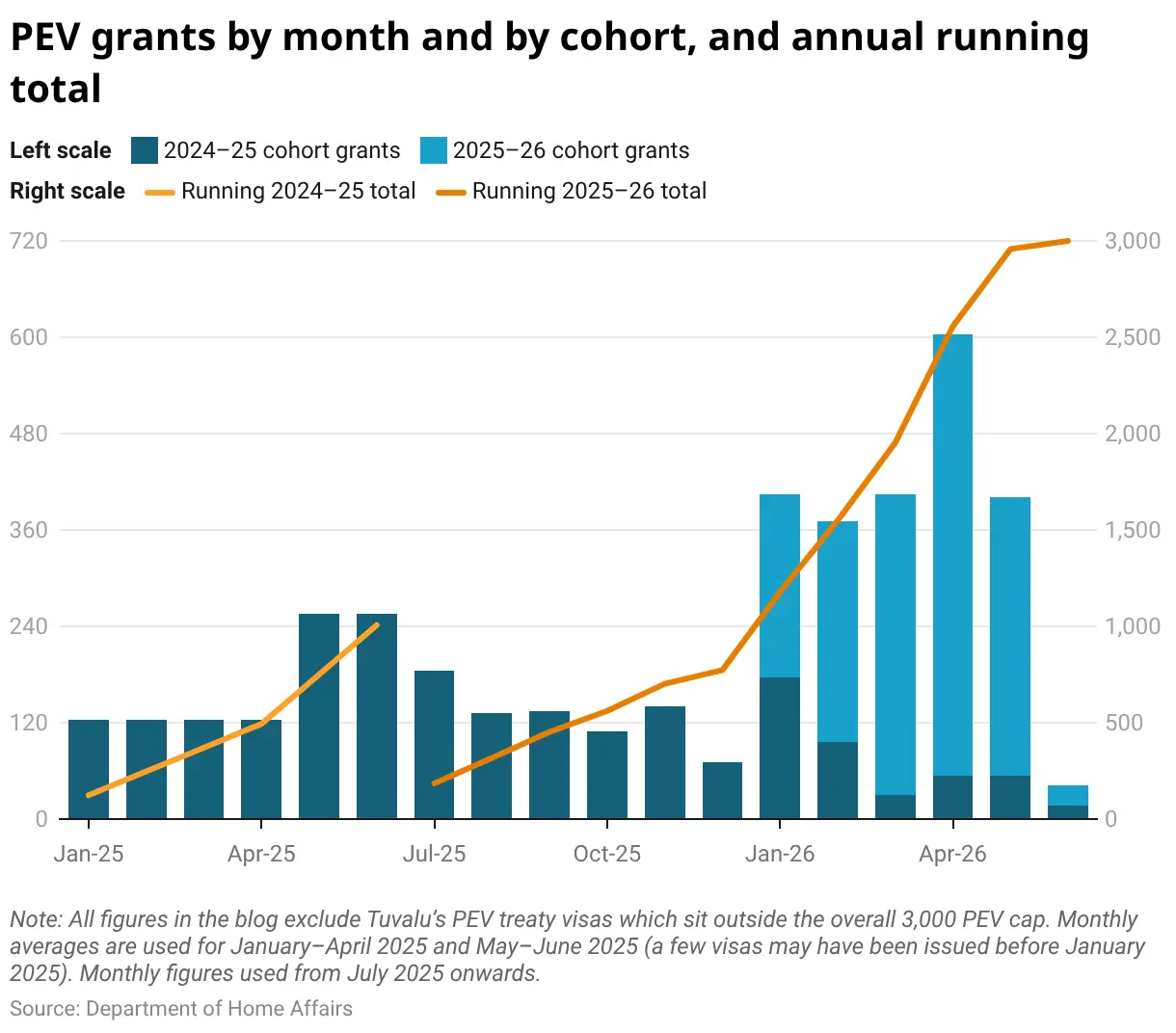
Australia slowed Pacific Engagement Visa (PEV) processing in June 2026 to keep within its limit of 3,000 visas in a single fiscal year, Stephen Howes and Finn Clarke wrote on the Devpolicy Blog.
Howes is Director of the Development Policy Centre and Professor of Economics at the Crawford School of Public Policy at The Australian National University. Clarke is a research officer at the centre. Their article uses Department of Home Affairs data to June 2026, covering the visa's first two years.
To get a PEV, applicants and their families must register for a ballot, be selected through that ballot to apply for a visa, and then meet the visa requirements, including an Australian job offer.
In the first two years, 4,006 PEV visas were granted out of 6,000 available, the authors wrote. The shortfall reflects a slow start, but the pace picked up: from January to May 2026, more than 400 visas a month were issued, over double earlier monthly rates.
After two years, the success rate for the 2024–25 cohort — visas granted divided by visas available — was 74 per cent. The 2025–26 cohort reached 59 per cent after just five months, a mark that took the earlier cohort 12 months to reach, they wrote.
The main reason for the difference is the number of applications, according to the article. Winners of the 2024–25 ballot lodged only 3,000 visa applications, while 2025–26 winners lodged 4,422, suggesting many more people were selected and invited to apply than the 3,000 quota for that year.
Those successful in the ballot are likely to lodge a visa application even without a job offer, in the hope one will come, the authors wrote. A lodgement is a sign of ballot success but no guarantee of a grant.
They recommended this "over-selection" in August last year. As of June, only 20 per cent of the growth in the aggregate success rate between cohorts came from more grants relative to applications, with the rest from more applications.
If another 3,000 visas are granted in 2026–27, the cumulative success rate will climb from 67 per cent in June 2026 to 78 per cent a year later, they wrote.
But the two decisions — not to issue more than 3,000 visas in a fiscal year, and to select more than 3,000 applicants from the ballot — mean some people selected in the ballot will never get a visa, Howes and Clarke wrote.
They gave the example of someone told in August 2026 of ballot success who finds a job at the end of December. If 3,000 visas have already been granted since July to the earlier cohort, that person may wait until the following July, and the employer may not hold the job open.
An alternative would be for Australia to recognise that it issued only 1,006 PEV visas in 2024–25, and to raise the annual limit above 3,000 for the next few years or remove it, they wrote.