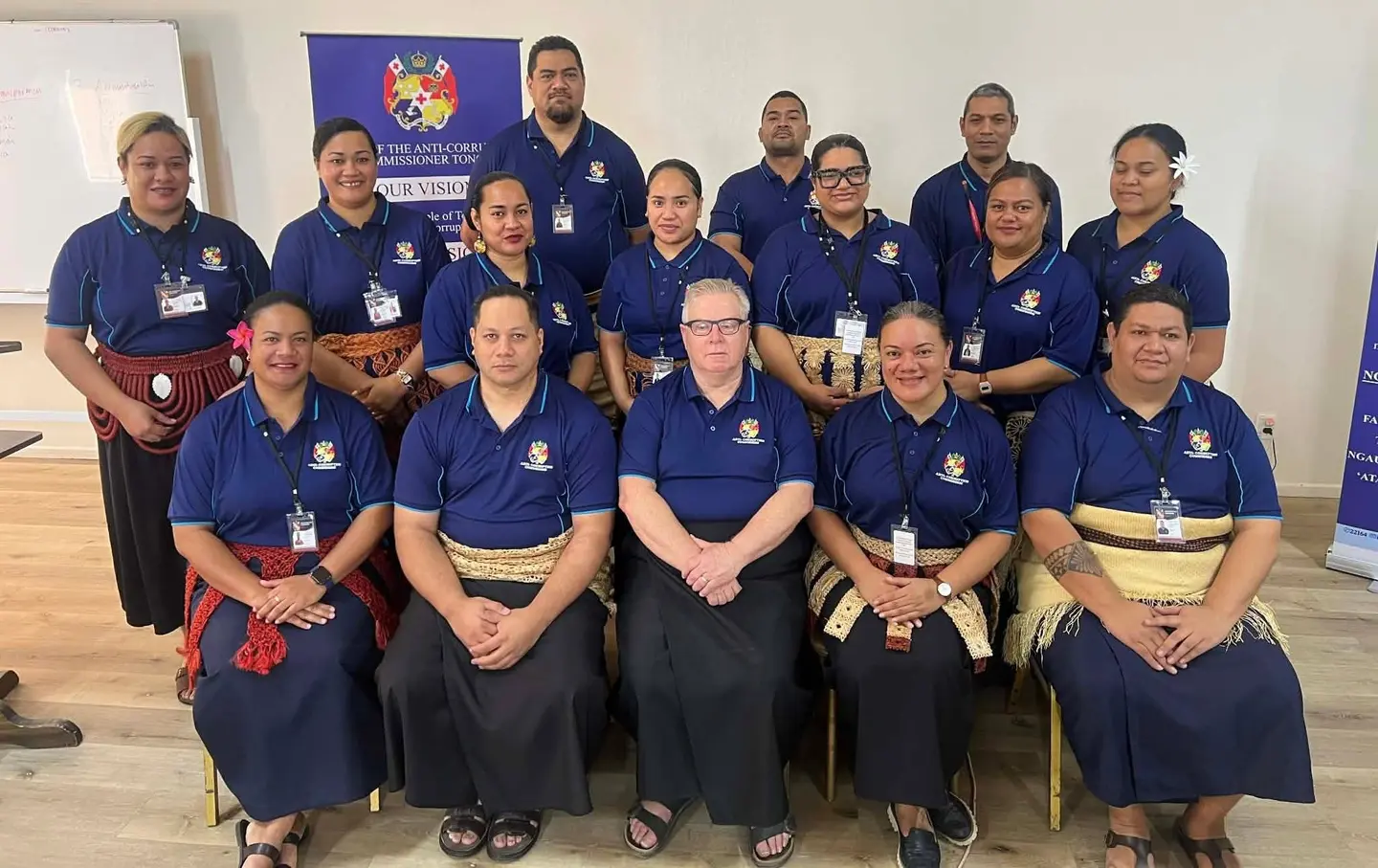
Anti-corruption agencies in small island states should be judged on whether they can show, decision by decision, that connections were disclosed and did not determine outcomes, Mele Fakatouato Mangisi wrote on the Devpolicy Blog.
Mangisi is Executive Director of the Office of the Anti-Corruption Commissioner in Tonga. Her article draws on practice in helping to establish Tonga's anti-corruption institution under the Anti-Corruption Commissioner Act, rather than on interviews or fieldwork, and she makes no representative claim about Tonga or the wider Pacific.
Discussion of independence usually begins with distance — protection from political direction, secure funding and the freedom to follow evidence without fear or favour, she wrote. Those safeguards are essential, and the United Nations Convention against Corruption and the Jakarta Principles are right to insist on them.
In small island societies, family ties, church affiliations, village connections and school networks overlap in ways that are normal and unavoidable, Mangisi wrote. A person making a complaint may be related to the person they are reporting, and an investigator may have attended school with a witness.
Relationships cannot be eliminated, she wrote, so the task for agencies is to keep them from determining public decisions. An agency may be legally independent on paper and still struggle to convince the public that its decisions are impartial.
She set out what she calls practised institutional independence: the conversion of formal autonomy into decisions that are impartial and can be explained and reviewed. The first three dimensions of her framework restate concerns already established in the literature on integrity institutions.
Structural authority asks whether an agency has the lawful position, powers and resources to decide independently. Operational capability asks whether it has the people and expertise to use that authority, and procedural fairness asks whether decisions are consistent and supported by recorded reasons.
The fourth dimension, relational integrity, is her own addition, asking whether personal, family, community and professional ties have been identified and kept from controlling decisions. Weakness in any one can turn formal independence into dependence or public distrust, she wrote.
Relationships are not inherently corrupt, Mangisi wrote, citing work by Grant Walton and David Jackson on reciprocity networks in Papua New Guinea, where the same ties can supply social support and enable favouritism. OECD guidance on conflicts of interest points to identifying, disclosing, assessing and managing them rather than automatic exclusion.
Controls need to be graded, she wrote, because in a small agency repeated recusals concentrate work in too few hands or stall a matter altogether. An officer with a minor connection might be kept out of the decision while doing a technical task under supervision, while another may need to leave the matter entirely.
Senior leaders should disclose their own connections first, so that staff understand that stepping aside is professional strength rather than embarrassment, Mangisi wrote. Pacific values and social networks should not be invoked to excuse favouritism or to avoid enforcing the law, she wrote; cultural understanding must sharpen accountability, not dilute it.
Large jurisdictions can move a matter to another office when conflicts arise and small ones often cannot, she wrote. External assistance pathways covering legal authority, information sharing, confidentiality and ownership of the decision should be settled before a difficult matter arrives.
She also argued for conflict checks at intake, allocation, key decision points and closure, and for separating critical decisions so that the officer who receives a complaint need not be the one who decides whether it proceeds. Complaint and investigation totals show activity, not whether independence is becoming credible, Mangisi wrote.