A former CARE Australia manager has set out his account of the financial misconduct allegations he made against the organisation in the 1990s and the Australian aid sector code of conduct that followed, in an article published on the Devpolicy Blog.
The article was written by Bernard Broughton, who was Director of Emergency Relief at CARE Australia from 1989 to 1990. He has since worked for 30 years as an independent evaluator of development and humanitarian programmes and is now retired.
A longer report was published by the Development Policy Centre on 1 October 2026, according to the article.
Broughton wrote that CARE Australia is now a respected and trusted NGO and that it would be wrong for his reflections to be used against the organisation as it now stands. He said the events held lessons for the aid sector.
He said that from its establishment in 1987, a substantial proportion of the funds CARE Australia raised as grants and donations went to cover its own costs. In his view, he wrote, this amounted to fraud on the Commonwealth and a breach of trust with the public.
On a monitoring mission to Africa in mid-1990 he obtained evidence he said showed CARE was overstating costs. His contact at the procurement company told him it was CARE, not the contractor, making the margin, he wrote.
In January 1991 he wrote to CARE's board alleging the organisation had received grant money from the Australian Agency for International Development, AusAID, beyond what was needed to transport relief maize from Zimbabwe. The savings involved were about A$1.25 million, according to the article.
Broughton said the then board chair, former prime minister Malcolm Fraser, telephoned him to defend retaining the savings as standard practice. He said Fraser warned him he would never get another job in Australia if he took the allegations to government.
AusAID told CARE and the responsible minister in February 1991 that it was satisfied with the handling of funds, without inspecting CARE's files and accounts, Broughton wrote. The Australian National Audit Office later said AusAID should have been more assiduous in its inquiries.
He said AusAID then identified more than A$440,000 CARE had not spent for approved purposes, and in 1994 more than A$1 million in accumulated surplus funds. In both cases the money was allowed to be applied to new projects, he wrote.
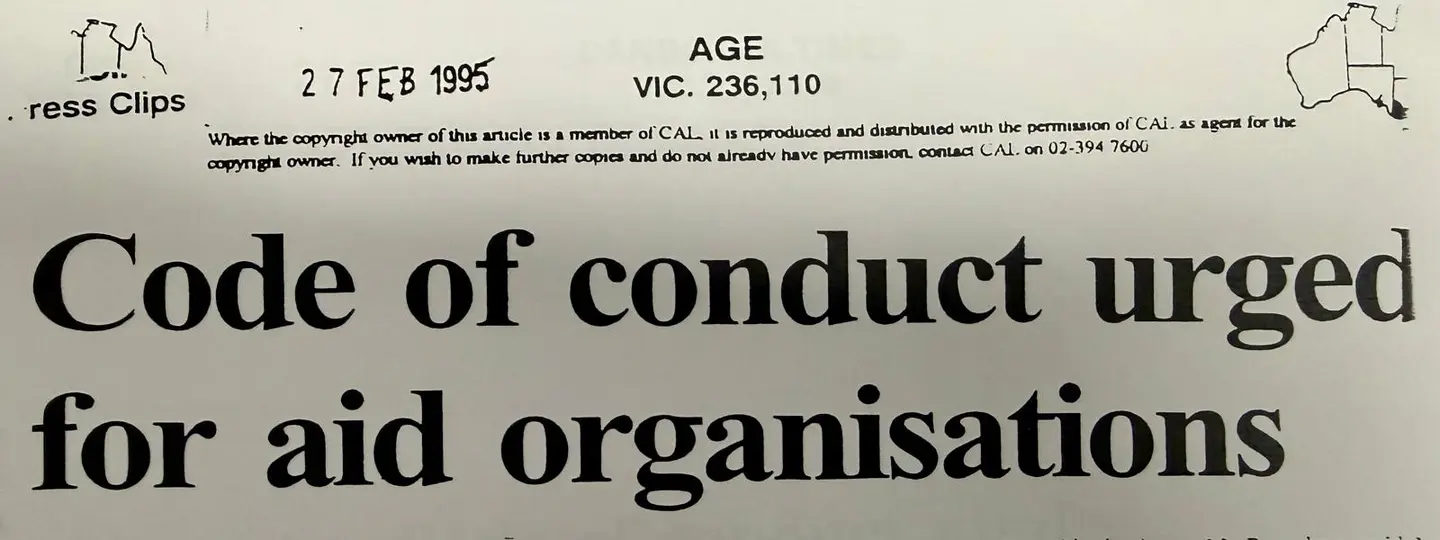
A television programme aired on 26 February 1995 and major newspapers followed. An audit by BDO Nelson Parkhill commissioned by AusAID found a Mozambique food aid project overstated by A$208,000 and a Sudan health project budget overstated by A$30,000, both repaid by CARE.
The matter was referred for consideration by the Director of Public Prosecutions but no charges were laid, according to the article. Broughton wrote that the total recovered by government was some A$238,000.
The Australian Council for International Development argued for self-regulation, he wrote, and a voluntary sector code was finalised in 1997, with signing it a condition of NGO accreditation with AusAID. CARE later joined ACFID and signed the code.
Broughton said the sector remains vulnerable because its legitimacy rests on trust, money is hard to follow in disaster settings, and disincentives to exposing wrongdoing persist. He said reporting by the Department of Foreign Affairs and Trade and the ACFID Code of Conduct Committee does not allow the public to judge how well the risk of financial wrongdoing in Australian aid is managed.