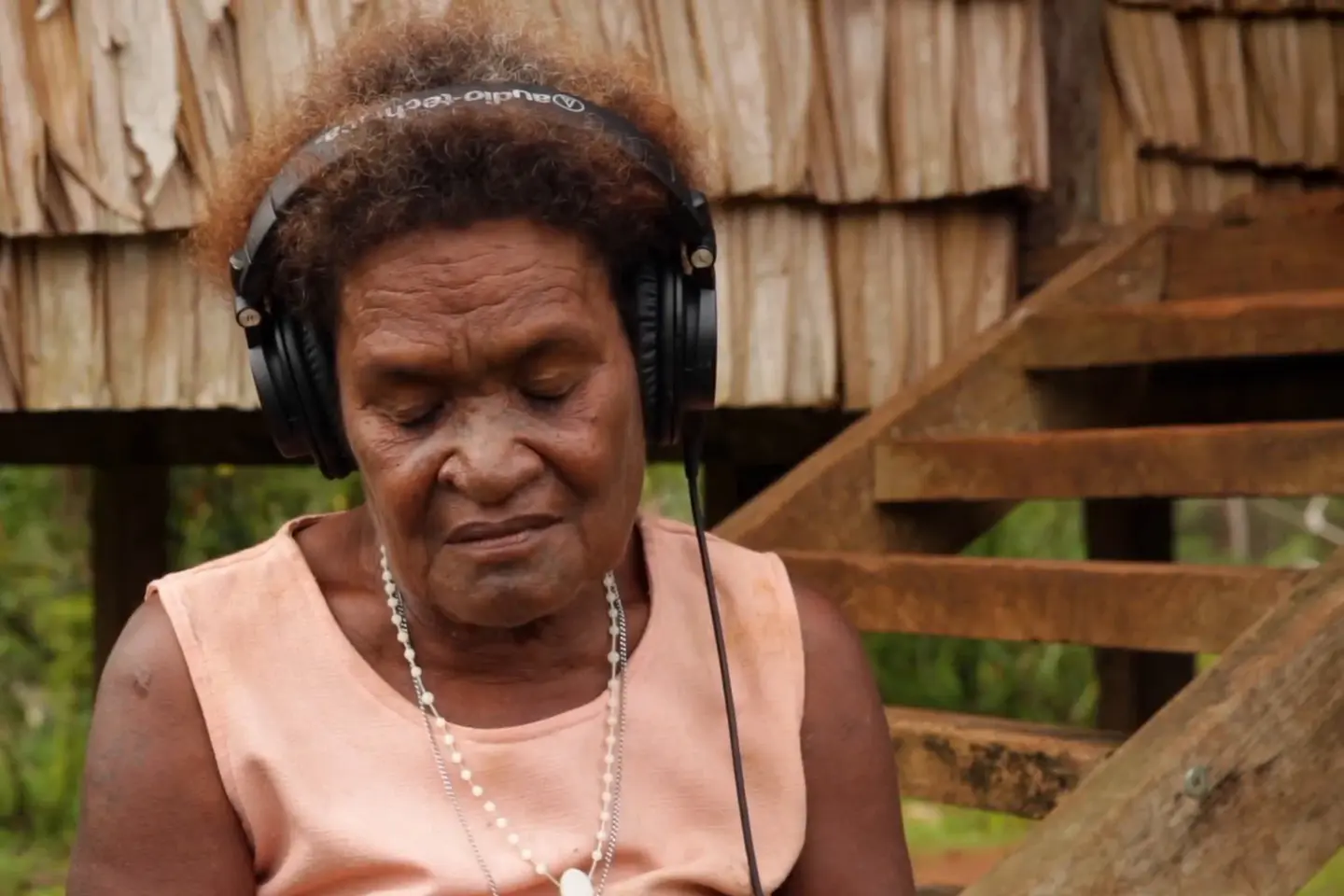
In August 1996, the director of Auvidis, the French label that published UNESCO's recordings, wrote to Hugo Zemp. Louis Bricard was glad, he wrote, that his label had turned down a number of requests to use them in pop records, because he considered such uses "the plundering of a treasure that it is our mission to watch over".
Zemp, a Swiss ethnomusicologist, had recorded Afunakwa singing a lullaby in Malaita in 1969. By then her voice was in a world hit, Deep Forest's Sweet Lullaby.
In October Zemp wrote back and turned Bricard's words on him. Since Auvidis had refused to sign, could it not have sued the musicians and their producer, who had gone ahead anyway? That "would have made it possible to send money to the Solomon Islands for the treasure that it is your mission to watch over". "Perhaps it is not too late to do something," he wrote.
The letter was never answered, and that upset Zemp deeply, says Steven Feld, the American anthropologist who was his friend for some fifty years. Zemp died in January, aged 88.
Thirty years later, a door has opened. Smithsonian Folkways in Washington, which acquired the UNESCO label and sells Afunakwa's recording today, told the Solomon Times that it keeps "royalties in escrow for accounts for which we do not have contact information". Its director, Maureen Loughran, asked to be put in touch with Afunakwa's family. On Thursday she said she would contact the Afunakwa Foundation, which her grandsons have set up. Whether any royalties are held for the recording is among the questions that "will take time to research", she said.
Folkways was answering questions from the Solomon Times, which had asked whether any money from the recording, on sale for more than fifty years, ever reached Afunakwa or her family. Eric Mouquet, who made Sweet Lullaby with Michel Sanchez, raised the same question in his answers for Tuesday's article.
Afunakwa's family says nothing from Sweet Lullaby has ever reached them. The older question is still open too: who allowed Deep Forest to use her voice in 1992, and was anyone paid? Several of the people who could answer have died, and the letters from that time contradict each other.
"Out of respect"
Zemp told his side in a 1996 article, which Feld summarised in his 2000 essay "A Sweet Lullaby for World Music".
In 1992 a UNESCO official, Noriko Aikawa, contacted him. Deep Forest wanted to sample a recording he had made in West Africa, for what he was told was a project for Earth Day. He listened to an extract over the phone and said no.
Then Francis Bebey called and urged him to think again. Bebey, a Cameroonian composer and writer, had worked for UNESCO. "Out of respect to him, I said O.K. on the telephone to him," Zemp wrote. Bebey later confirmed to Zemp that the producer at Céline Music, one of the companies behind the album, had enlisted him to persuade Zemp.
Bebey's letter to Céline Music, as Zemp quoted it, said that Zemp had "consented to let you use forty seconds of music taken from his disc", for its "project for The Day of the Earth". The published quotation leaves out the words that follow "his disc", so it does not show which disc.
When Zemp finally listened to the album, he heard nothing from his West African recording. He heard Afunakwa. He had been told the project was "about African forests", Feld says.
Lacksman's company co-produced the album with Céline Music. Its only part, he says, was the studio: six months of recording and mixing. "Everything else, the contracts, the permissions, the deals with the musicians and arrangers, was the responsibility of Céline Music."
He saw a letter from Bebey in Céline Music's offices, but does not remember its details. Another of the producers, Vline Buggy, told him in 1991 or 1992 that she had made an agreement with "the original record company", "thanks to Francis Bebey's intervention", he says. He does not remember which company. Bebey died in 2001, and Buggy last month, aged 97. Without a copy, there is no way to check whether it was the letter Zemp quoted.

Two letters, one question
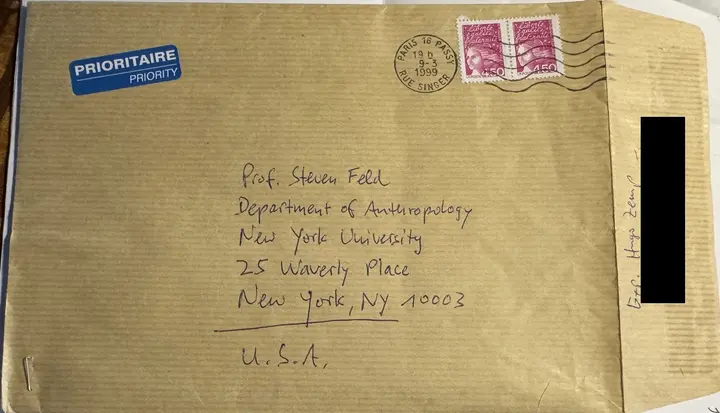
The Solomon Times has seen copies of three of the letters exchanged in 1996. Zemp posted them to Feld in 1999.
In July 1996, Zemp wrote to Mouquet and Sanchez. As their reply quotes him, he accused them of wrongly claiming Sweet Lullaby as their own composition, "by stealing the melody that belongs to the Baegu people and by stealing the voice of the singer, Afunakwa". He sent a copy to Auvidis.
Auvidis answered first. On 17 February 1992, Bricard wrote, a lawyer for Céline Music had asked to use excerpts from UNESCO records of the Solomon Islands, Cameroon and the Central African Republic. Auvidis was against it. The music "belonged to the peoples who had entrusted it to UNESCO" to preserve their heritage, and Auvidis had no power to let it be distorted for a pop record. It refused to sign an agreement, and above all refused any payment.
What Auvidis told the lawyer, by Bricard's account, was this: on 27 March 1992, after informing UNESCO of its decision, it said it was passing the file to UNESCO "for the problems of authorisation and conditions", on the pretext that it was "a special case".
Deep Forest answered Zemp on 1 October. Sanchez and Mouquet called his letter "insulting and inaccurate", and wrote that Auvidis had authorised the use and been paid for it. If he did not stop, they would take legal action against him for spreading false information likely to harm their professional reputation. They also wrote that they were the album's performers and composers, not its producers or publishers, and that the statements on its sleeve had been printed without their agreement, or even their knowledge. For more information, they added, Zemp should contact the album's producer and Sony Music.
So the two letters disagree on both points: whether Auvidis authorised the use, and whether it was paid. Nine days later, Zemp sent Bricard a copy of Deep Forest's letter, with the questions quoted at the start of this article. He added:
If anyone could take on Deep Forest, it is a big record company like yours rather than an individual like me.
Another label had taken the step he was asking for. Le Chant du Monde, which published the Musée de l'Homme record series that Zemp directed, had told him that Deep Forest's album sampled an African recording from that series without a licence. It pursued the case, and Céline Music paid an out-of-court settlement, Feld wrote in 2000.
Zemp also wrote a postscript about the letters for his article, published in December 1996 in the Yearbook for Traditional Music. The editor cut its conclusion, that the two letters could not both be true, for fear of legal action, Feld wrote. The journal was itself sponsored by UNESCO.
Today Mouquet stands by what he and Sanchez wrote about the authorisation. The two gave the producers a list of the recordings they had used, Rorogwela among them, he told the Solomon Times. "They were responsible for obtaining the necessary authorisations from the rights holders, and we had been told that these authorisations had been obtained." A track using an excerpt of the Drummers of Burundi was dropped from the album, he says, because the record company Arion had not given its authorisation.
This month, Mouquet says, Lacksman, contacted by his side, confirmed that an agreement was made with Auvidis at the time. Mouquet did not negotiate or sign it himself, but has "no reason to question" what he was told. Lacksman puts it differently. "I did not 'confirm'," he told the Solomon Times. When Mouquet's manager phoned him, he says, he told the manager that he remembered Céline Music telling him an agreement had been made. He does not remember which record company it was with.
Mouquet, asked on Wednesday who received the payment mentioned in the 1996 letter, and whether he knew at the time of UNESCO's reported opinion, had not replied by publication.
Three labels were involved, then. Le Chant du Monde pursued its claim and was paid, Feld wrote. Arion had not given its authorisation, Mouquet says, and the track was dropped. On Auvidis, the letters disagree.
UNESCO's part
UNESCO's name was on Afunakwa's record, and Deep Forest's liner notes, as Feld quoted them in 2000, invoked it: "the musical creation of Deep Forest has received the support of UNESCO and of two musicologists", one of them Zemp.
By Zemp's account, UNESCO had been willing in 1992 to allow samples if the recordists agreed and the musicians and recordings were properly credited. The album did not say that the voice came from the Solomon Islands, or name Afunakwa. Its origin "should have been clearly mentioned", Mouquet said this month.
Zemp later went through UNESCO's correspondence file with Aikawa. According to Feld's summary of Zemp's article, it held a letter from Auvidis asking UNESCO to confirm the authorisation and to say whether the rights were free or what should be paid, and Aikawa never answered it. UNESCO was in favour, by Bricard's account, but in Feld's words Zemp "discovered that UNESCO authorized no sampling of his recordings to Auvidis or to Celine Music".
Auvidis would not sign and passed the matter to UNESCO, and UNESCO never answered: to the best of his knowledge, Feld told the Solomon Times this week, that is how Zemp understood it. It is also how Zemp told the story the last time the two discussed it together before an audience, Feld says: at a seminar for ethnomusicology students and professors in Paris in 2004, after a French translation of Feld's essay was published.
In 2010 the business records of UNESCO's music collection went to the Smithsonian. According to the catalogue of the Smithsonian's archives in Washington, they include a folder titled "Deep Forest, Hugo Zemp Case", with papers from 1992, 1995 and 2004 to 2006 and a photocopy of a contract numbered 220.115. The folder has not been digitised. The Solomon Times asked the archive on Tuesday what it holds. Folkways has consulted the archivists, Loughran said on Thursday, and the questions will take time to research.
UNESCO was asked on Wednesday whether it has a record of its position in 1992, and whether it received any payment for the use of the recording. It had not replied by publication.
Who is paid today
Sony Music still markets the original 1992 recordings, Mouquet says. He and Sanchez were paid a fee for their work on the album and received no artist royalties on its sales, he says.
For Sweet Lullaby, Sacem, the French society that collects authors' royalties, lists Mouquet and Sanchez as arrangers, two publishers, and Sony Music Publishing France as sub-publisher, but no author or composer. Mouquet says the authors' royalties he and Sanchez receive are for their composition and arrangement work, separate from any rights in Zemp's recording.
Céline Music is now part of EMI Music Publishing France, Lacksman says, and EMI Music Publishing belongs to Sony. Sony Music Publishing France was asked on 18 October whether it holds Céline Music's catalogue and an authorisation for the recording, and whether any income from Sweet Lullaby has ever reached Solomon Islands. On Wednesday it was asked whether Céline Music's archives contain Bebey's letter or any record of an agreement or payment. It had not replied by publication.
Folkways acquired the UNESCO label after Sweet Lullaby was made. The Solomon Times also asked it what Afunakwa's family would need to show to receive any royalties held for her, and whether they could go to a community body such as a foundation. Those questions, too, will take time to research, Loughran said. Smithsonian Folkways has "a history and practice of updating our information as more research is available to us", she said, and because of the correspondence about the foundation, "we are able to do so with this album".
Passing it on
Zemp never let the letters go. Feld met him in Paris in 1974, as a student, and first heard the Baegu record there. Zemp gave him a copy when he went home to the United States. "I still have it," Feld says. The two visited each other regularly in the United States and France, and last met in Basel in 2023, shortly before Zemp fell ill. Feld, now a distinguished professor emeritus of anthropology and music at the University of New Mexico, began his own research in Papua New Guinea in 1976, and has taught the record for many years in his courses on Melanesian music.
Over the fifty years he knew him, Feld says, Zemp was "rigorous, precise, careful, and deeply ethical", and as editor of the Musée de l'Homme's record series "meticulous with regard to credits, payments, and contracts". "It is simply inconceivable to me that he would in any way have been slack or less than 100% precise with regard to any kind of license for music sampling," Feld says.
In March 1999 Zemp posted Feld copies of the 1996 letters, so that Feld's essay would get them right. Zemp reviewed and approved the essay's final version, Feld says, and insisted on the importance of those letters "until the very end". This week Feld found them in his files and sent the Solomon Times photographs of them.
The next link was a musician. Matt Singmin contacted Feld at the very start of his project, which began eight years ago with a yoga remix of Sweet Lullaby. The project became the film Searching for Afunakwa, and Feld has played, in his words, "a supportive role" in it ever since. Zemp died nine months before the film was released.
What comes next
In the film, the family asks for her to be named. This month, Deep Forest's YouTube page began to do so. Mouquet has said he is open to a dialogue with the family, with Singmin as a bridge, and to a musical project in her honour. Singmin has left the answer to the family.
Solomon Islands still has no law that protects a community's traditional songs. A law on traditional knowledge and expressions of culture is still a draft, which the Ministry of Culture and Tourism named a priority reform on 16 October. The ministry's Director of Culture, Dennis Marita, said he would respond to the Solomon Times' questions by Friday, as the ministry is busy with the Pacific Tourism Ministers Meeting.
Such cases can end in an agreement. In 1999 a lawsuit over Enigma's hit Return to Innocence ended in a settlement with two Amis singers from Taiwan whose recorded voices it used. They were to get full credit, including liner notes on all future releases, and a foundation was to be set up to preserve their culture, the announcement of the settlement said.
On 9 December the British High Commission in Honiara will screen the film to launch the Afunakwa Foundation. Her grandsons set it up with Celsus Talifilu, so that anyone using the song has a legal body to deal with. Feld hopes the film and the foundation "can finally lead to the acknowledgement and compensation this story calls for".
Watch the full film: Searching for Afunakwa.