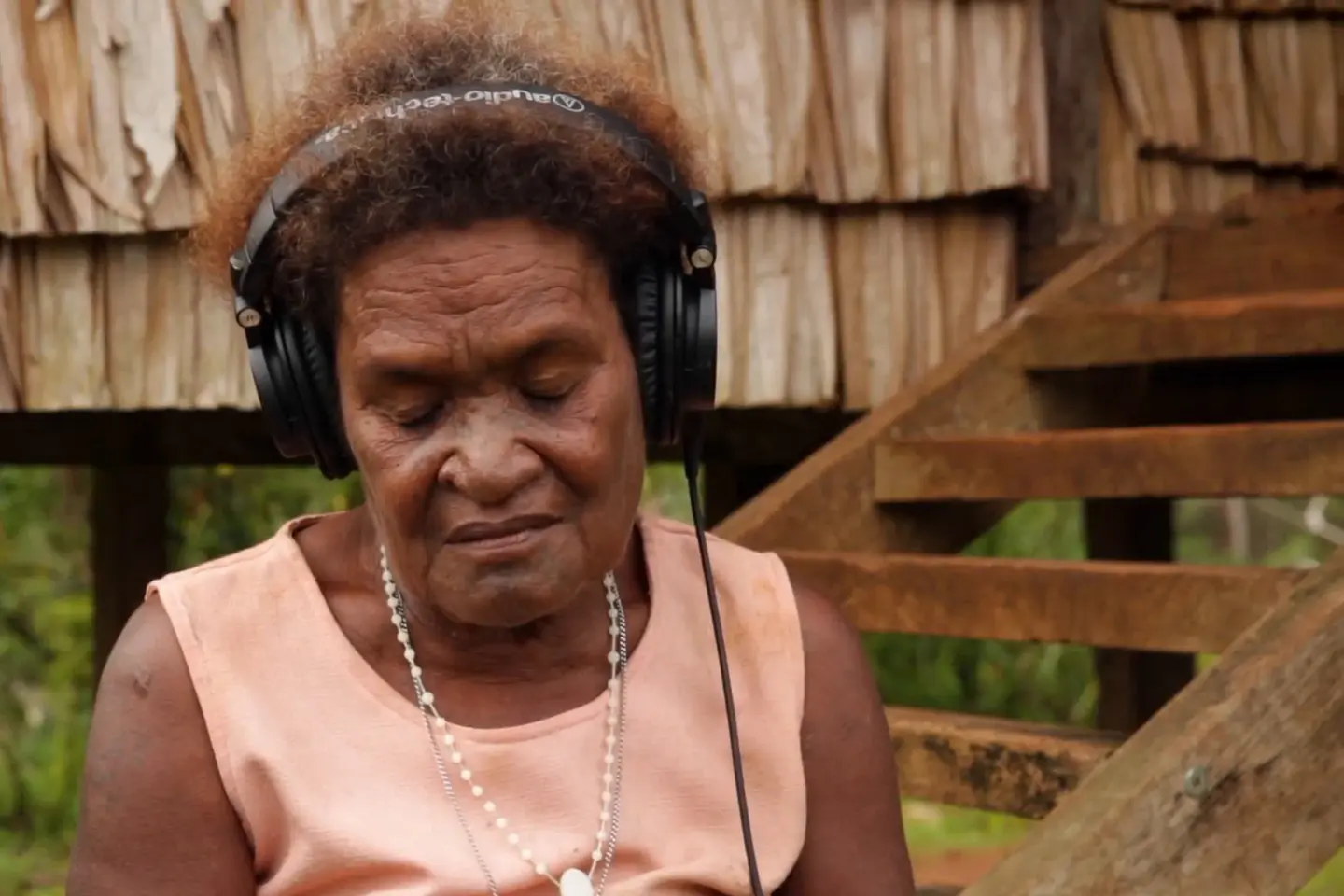
For more than thirty years, millions of people have heard her voice without knowing her name. The woman singing at the start of Deep Forest's 1992 hit Sweet Lullaby is Afunakwa, a Baegu woman from north-east Malaita. She was recorded in 1969 singing Rorogwela, a lullaby in which an older child begs a little brother to stop crying, because their mother and father have died.
Her voice went around the world on an album that presented its music as African. Her name did not go with it, and her family says none of the money ever reached Malaita. Afunakwa herself died in 1987, the family says, five years before Sweet Lullaby was released.
Now a documentary, Searching for Afunakwa, has found her family and lets them tell the story in their own words. It began with a remix. Its maker, the Sydney musician Matt Singmin, wanted to turn Sweet Lullaby into a track for yoga classes, and when he tried to clear the sample, the questions he ran into about consent and ownership took him to Malaita instead. The film asks what responsibility artists carry when music moves between cultures, and whether it is ever too late to put past mistakes right.
This month, Deep Forest began to name her as the singer. Eric Mouquet, who made the album with Michel Sanchez, told the Solomon Times that the two musicians knew in 1992 that the voice came from Solomon Islands, and that its origin "should have been clearly mentioned".

The full film, 42 minutes, is free to watch on YouTube: Searching for Afunakwa.
From a remix to a film
Singmin is an English musician and DJ based in Sydney. Under the name SOLON he makes slow, meditative electronic music, much of it for savasana, the rest at the end of a yoga class, and he plays at yoga events as one half of The Future Sound of Yoga. He calls himself an unexpected documentary filmmaker.
The Sweet Lullaby remix was meant for those classes. When he tried to clear the sample, he says, the questions it raised sent him into the song's history, and the more he read, the clearer it became that the only ethical way to release his track was to go to the source and ask the people it came from for their blessing. He asked the filmmaker Jonathan Jenkins to come with him.
"What began as a simple remix evolved into a much larger story," Singmin says. "Once I understood the history, I couldn't simply release the track and move on. I had to find another way." He thought the project would take a few months. That was eight years ago.
"Acknowledgement is very important"
In the film, released on YouTube on 3 October, Singmin and Jenkins travel up the Ata'a River to Fulinui, where the recording was made, and to Kalifasia, the village where Afunakwa lived and died. They meet Helen, her last surviving child, and three of her grandsons, Clement Iata, Tony Kwaomae and Claudius Iluga. The family has no photograph of her.
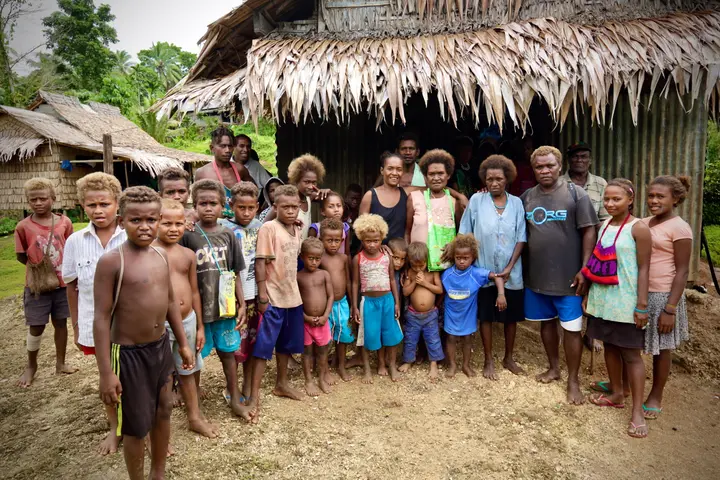
Tony Kwaomae, a school principal, remembers his grandmother singing the lullaby to the grandchildren. He says the family knew her voice at once when Sweet Lullaby came on the radio, even though the music video showed people from Africa. "Deep Forest should acknowledge who is the singer, who is the owner of the song," he says. "Acknowledgement is very important."
Celsus Talifilu, whose father Saverio Talifilu was the Baegu headman who arranged the recording in 1969, says neither Afunakwa's relatives nor the Baegu people have received anything from the song. "Of course we are happy a voice from our place is enjoyed by people out there, as music always be," he says. "But please recognise that it was from this humble beginning that this thing came about."
For Tony's brother Clement Iata, it is a question of truth. "The truth always channel itself to the light," he says.
The film also dwells on what the words mean. Rorogwela is a sad song, Tony explains: two orphans, the older one trying to stop the younger one from crying. In Sweet Lullaby it became an upbeat dance track, something the film says sits uncomfortably with the story the song tells.
How her voice travelled
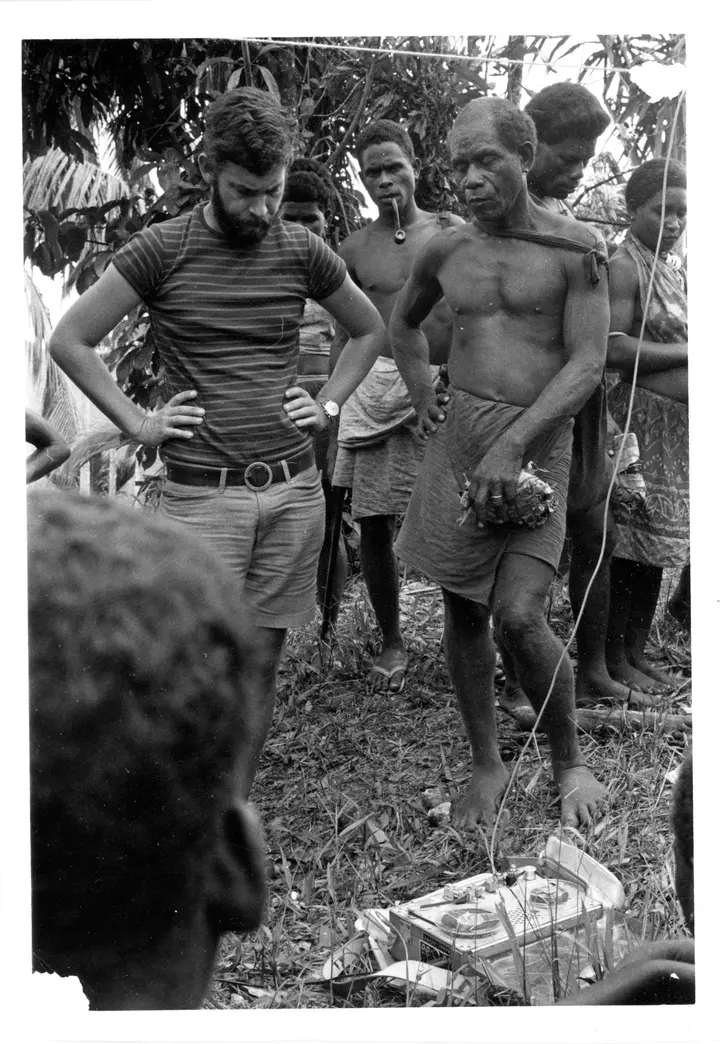
The Swiss ethnomusicologist Hugo Zemp recorded Afunakwa in September 1969, on a field trip for France's national research centre, the CNRS. UNESCO released the recording in 1973 on a record of Fataleka and Baegu music from Malaita, and it was reissued on CD in 1990. Zemp's notes on that record name the singer: "Rorogwela lullaby, sung by Afunakwa." Smithsonian Folkways in the United States still sells it, with Afunakwa listed as the artist. Zemp died in January this year, aged 88.
Mouquet says Sanchez bought the record in Paris and brought it to the studio. The album had been conceived around African music, especially Pygmy songs, under the working title "Deep Pygmy", and the producers kept presenting it that way after Sweet Lullaby was added, he says. He and Sanchez had no part in the booklet or the credits, which were the production team's job.
Sweet Lullaby reached the top ten in Britain and Australia, the album sold millions of copies, and the song was used in television advertising, including for Porsche and Coca-Cola. The album gave no source for the voice.
Zemp only found out about the sample after the record's success. According to the American anthropologist Steven Feld, who studied the case in 2000, Zemp had never been asked for consent to use his Solomon Islands recording. In 1996 Zemp wrote to Mouquet and Sanchez accusing them of stealing a tune that belongs to the Baegu people, and asked them to pay part of their profits back to the real owners of the music. They replied that their project had the full authorisation of Auvidis, the label that licensed UNESCO's recordings.
The credit
On 13 October, the description under Deep Forest's official Sweet Lullaby video on YouTube, watched more than five million times, still read "Music composed by Eric Mouquet and Michel Sanchez", an archived copy shows. By 17 October it read: "Based on 'Rorogwela', a traditional lullaby from the Solomon Islands, performed by Afunakwa and recorded by ethnomusicologist Hugo Zemp." The two are now credited with the "musical arrangement".
Mouquet says the old text was a mistake by the band's social media team, "with no intention whatsoever of concealing the origin of the music or of harming anyone", and that he has always explained the origin of the voices, including Afunakwa's, in interviews. Sweet Lullaby has been registered as an arrangement with Sacem, the French authors' society, since 1992, he says. Asked whether the new credit will also appear on streaming services, on reissues and at Sacem, he said he was "in favour" of the information on every use of the song reflecting "as clearly as possible the origin of this music and Afunakwa's essential contribution".
The money
Afunakwa's family say none of the money from Sweet Lullaby has reached them.
Mouquet says he and Sanchez were paid about 60,000 Belgian francs each (roughly 1,500 euros) for their work on the album and received no artist royalties on its sales under the original production agreement; Sony Music still markets the original recordings. The two receive authors' royalties for their composition and arrangement work, including when the tracks are broadcast or played in concert, he says.
Last week Mouquet acknowledged to the French magazine Télérama that beyond the legal question there was a moral one, and that the situation was not right. To the Solomon Times, he called the film, in a phrase from Télérama's review, "legitimate but incomplete".
He also asks whether Afunakwa or her family have ever been paid for Zemp's own recording, which has been on sale for more than fifty years, independently of Deep Forest. The Solomon Times has put that question to Smithsonian Folkways, whose staff have passed it to the label's director.
Permission
Whether anyone gave permission to use the recording is disputed. Mouquet stands by what he and Sanchez told Zemp in 1996. The producers were in charge of permissions and told the musicians they had been obtained, he says, and one of the producers, Dan Lacksman, confirmed to him a few days ago that an agreement was made with Auvidis at the time. Lacksman told the Solomon Times that another of the producers had assured him in 1991 or 1992 of an agreement with the original record company, but that he does not remember which company it was. A letter of 10 October 1996 from Louis Bricard, then director of Auvidis, quoted by Feld, says no permission was ever granted and no agreement signed. The Solomon Times will set out what the documents show on Friday.
A wider problem
Music scholars have written about Sweet Lullaby since the 1990s as a case of a traditional recording turned into a global hit while neither the singer's name nor any payment went back to her community.
Solomon Islands still has no law that protects a community's traditional songs. The Copyright Act of 1987 says nothing about them. A law on traditional knowledge and expressions of culture exists only as a draft; the Ministry of Culture and Tourism named it a priority reform last Friday.
The film ends with the idea of the Afunakwa Foundation, set up by her grandsons and Celsus Talifilu as a legal body that anyone using the song can deal with, so that the benefit goes to the Baegu community. The foundation says it is a registered charity under the Charitable Trusts Act, based in Auki, and that its early priorities may include children's clothing, medical supplies, malaria nets and school textbooks.
The British High Commission in Honiara will host a screening of the film on Wednesday 9 December, from 6pm to 8.30pm, to mark the foundation's launch. Singmin says he will fly in for it.
"It is so important that Solomon Islands culture is widely recognised and that its musical roots are appreciated by all and not wrongly appropriated to other sources," the High Commissioner, Paul Turner, told the Solomon Times. "The melody is rich and beautiful and the story behind the voice is a powerful reminder of the importance of preserving the cultural origins of these islands."
"A new chapter"
Mouquet says he talked with Singmin for more than an hour and a half after the film came out, and that he is "personally open" to building something positive with the family through a dialogue, with Singmin as "a bridge". In a message to Afunakwa's family and the people of Malaita, he expressed his "deep respect" for them and for Afunakwa, and wrote that her voice "holds an essential place in this music and deserves to be fully recognised". If the family wishes, he would like to think with them "about a musical project that would pay tribute to Afunakwa and her voice", and hopes to "open a new chapter, based on dialogue, respect and recognition".
Singmin said he hoped the dialogue "can lead to something positive for Afunakwa's family and community", but that "at this stage it's still unclear where this will all go". He has left it to the family to decide how to respond.
Michel Sanchez, who has since left Deep Forest, has not yet replied to a message sent through his website on Sunday; Mouquet says the two have not been in touch for many years. Sony Music Publishing France, which Sacem lists as the song's sub-publisher, has not yet replied.
On Friday, the Solomon Times looks at who is paid for Sweet Lullaby today, what the documents say about permission, and what Solomon Islands law could do for a song like Rorogwela.
Watch the full film: Searching for Afunakwa.
How we reported this: Eric Mouquet answered our questions in writing, in French. The translations are ours; he was sent the English of every passage about him before publication, to check that it matches what he meant. The family's words are from the film and its press kit.