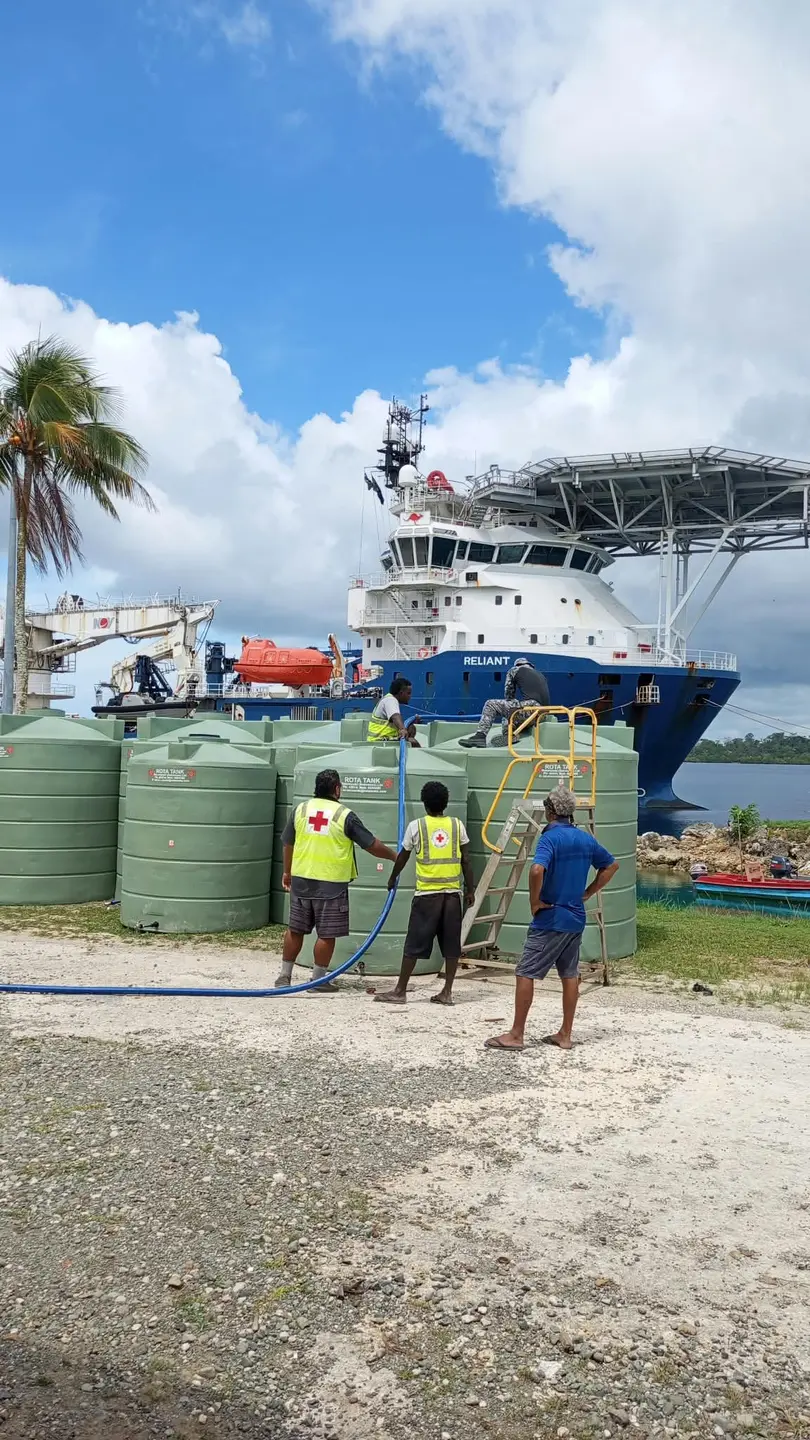
The Australian Government has delivered 535,000 litres of drinking water to communities in Western Province as part of the Solomon Islands Government's drought response, the Australian High Commission said on 16 November 2026.
Of that total, 250,000 litres went to Gizo, 185,000 litres to Noro and surrounding communities, and 50,000 litres each to Nila and Simbo.
The High Commission said the water was provided to support communities facing severe water shortages caused by a strong El Niño event. The Solomon Islands Meteorological Service issued a nationwide drought warning in October 2026.
The operation allowed schools and the hospital in Gizo to reopen after weeks of reduced operating hours and forced closures caused by the water shortages, the High Commission said.
The drinking water was generated by the Australian Defence Vessel Reliant using its onboard reverse osmosis desalination plant, which turns sea water into drinking water. The Australian Defence Force worked with the National Disaster Management Office (NDMO), the Western Provincial Government and Solomon Islands Red Cross volunteers to get the water to communities most in need.
Australian High Commissioner Jeff Roach said the operation was a tangible example of the strength of the Solomon Islands–Australia partnership, and that in times of crisis Australia stands alongside the people of Solomon Islands. He commended the work of the NDMO, Red Cross volunteers and ADF personnel who completed the operation.
National Disaster Council chair and Ministry of Environment, Climate Change, Disaster Management and Meteorology Permanent Secretary David Hiriasia said the government has been focused on finding solutions for communities struggling with water shortages, and that it appreciated Australia's support to get essential services such as schools and medical clinics operating again.
Defence Adviser to Solomon Islands Captain Emma Griffiths said the mission showed the vessel's ability to provide practical support to Pacific partners when communities face environmental and humanitarian challenges.
"There's been little or no rain for the past eight months. Some of those areas and smaller islands are now severely affected, with some of the schools and health facilities having to close because they do not have those potable fresh water facilities," Griffiths said.
She said she was glad to see those schools and health facilities opening again with the delivery of the water.
The operation follows the delivery of 49,000 litres of drinking water in Rennell and Bellona Province in October 2026. That operation was led by the NDMO and supported by the Australian Government and the non-government vessel HELPR-1.