
Improving access to health care for Pacific children with respiratory illnesses requires health systems to better understand the worlds their families move through, a Fijian public health doctor says. For Indigenous Fijians, she writes, those are traditional belief, Christian faith and Western medicine.
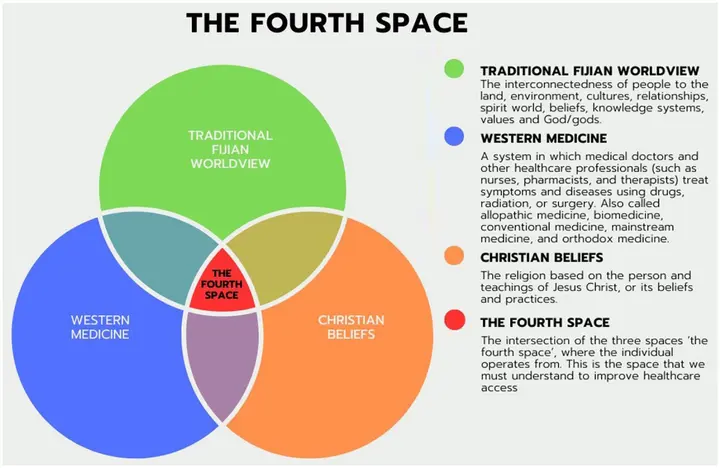
Dr Sainimere Boladuadua, a public health medicine specialist and doctoral candidate at the University of Auckland, calls the place where they meet "the fourth space". Her paper, published online on 17 October in AlterNative: An International Journal of Indigenous Peoples, is a commentary that draws on two reviews of published research.
A baby breathing fast
She sketches an imagined scenario. An Indigenous Fijian mother, six weeks after giving birth, notices that her baby is breathing faster than usual and is not feeding well. She might consult a traditional healer or give the baby herbal medicine. Her mother or grandmother might prompt her to think about which relationship she may have broken or upset, and to carry out a ritual of reconciliation. They might also ask a church elder or minister to pray over the baby.
"These might take a few days, during which the baby's condition deteriorates," she writes. Then the mother might ask the village health worker, who advises that urgent attention is needed at the nearest hospital and arranges the referral.
In Fiji, she writes, traditional medicine is often seen as inferior to Western medicine, and is even blamed when patients reach hospital late. From her own work in obstetric care in Fiji, she writes, she would see expectant mothers who were overdue for delivery take herbal medicine to induce labour, or consult traditional birth attendants, before coming to hospital. "Once this history is elicited, the woman is often berated," she writes.
Three worlds
In the Indigenous Fijian worldview, the first space, health comes from harmony within the vanua: the land, and the people, relationships, values and ways of life tied to it. In this view, a broken relationship can show itself as sickness or even death. Christianity, the second space, brings its own teaching on forgiveness and reconciliation. The third space is Western medicine. Fiji's health system is built on it and discourages other forms of care, she writes, offering "a binary proposition to a pluralist society".
The paper cites estimates that lower respiratory infections such as pneumonia accounted for 13.1 per cent of deaths of children under five worldwide in 2016, and that Oceania had the highest rate of these infections among children under five in the world. In Fiji, a 2012 study it cites found pneumonia the most common diagnosis for young children at outpatient clinics.
In Solomon Islands
The paper does not look at Solomon Islands, and Boladuadua's own research, carried out with children and families in Fiji, did not include anyone from here. But asked by Solomon Times, she said she sees the fourth space at work "in Solomon Islands and across Melanesia". "Whether in Fiji, elsewhere in the Pacific, or in countries in Africa, health decisions are often shaped by the interaction of family, culture, faith, traditional healing practices and biomedical care," she said. "Solomon Islands would be no different."
Here, pneumonia and other lower respiratory infections killed an estimated 57 children under five in 2024, about 13 per cent of deaths at that age, down from an estimated 112 in 2015, according to estimates by Johns Hopkins University published by UNICEF. Three earlier pieces of research looked at how people here seek care.
What would she want a mother in a Solomon Islands village to know if her baby is breathing fast? "That fast breathing is a danger sign and not something to ignore," Boladuadua said. "A mother knows her baby best and if she notices that her baby is breathing faster than usual or having difficulty breathing, she should seek medical help as soon as possible." The people around her should take her concerns seriously and help her get care, she said. Fast breathing in a young child can be a sign of a serious respiratory infection such as pneumonia, she said, and early treatment can save lives. "Other related symptoms to watch out for are cough, fever, difficulty feeding, chest indrawing, unusual sleepiness or grunting while breathing. It’s important to seek urgent medical assessment for these."
What she proposes
Boladuadua writes that Fiji's health system should acknowledge traditional and complementary medicine as an important form of health care, look for ways to work with it to make sure practices are safe, and adapt to the fourth space people operate in. "Consideration of this fourth space is necessary if access to health care for Indigenous populations is to be improved," she writes.
"Healthcare access is not just about whether services are available," she said in a statement released by the university. "It's also about whether people feel seen, understood and respected when they seek care."
She wrote the commentary during a fellowship from the Health Research Council of New Zealand. Her fellowship project looks at how to improve access to health care for parents whose young children get sick with acute respiratory infections, focusing on Fiji, with a New Zealand component.