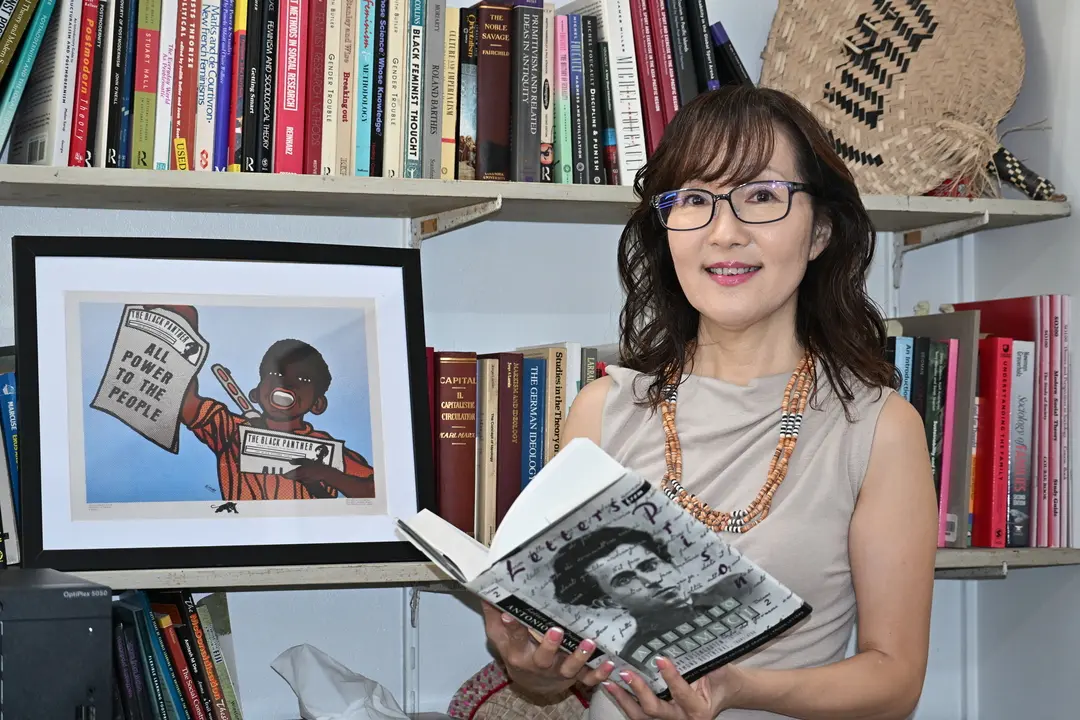
Yoko Kanemasu has been promoted to full Professor in Sociology at The University of the South Pacific (USP), after a career of more than three decades in research on social justice, gender and identity.
Kanemasu said that when she finished her undergraduate studies in Japan in the 1990s she was told there was no point in a woman going further.
"When I completed my undergraduate, I was told that it was pointless for a woman to pursue further study," she said. She overcame it, she said, by stubbornly sticking with what she wanted to do.
Her time at USP began in the early 1990s as a Master of Arts student. She worked as a research attache at the Embassy of Japan in Suva to fund her doctoral studies, then took a PhD in Sociology through the University of New South Wales as a distance scholar while teaching at USP. Apart from a short period in the United Kingdom, she has been at USP since returning in 2010.
Kanemasu said she had spent more time in Fiji and the Pacific than in Japan, and had found considerable cultural resonance between Japan and many Pacific communities, particularly in the emphasis on relational harmony and respect.
Her student years introduced her to a decolonial approach to sociology, shaped by Pacific scholars including Professor Vijay Naidu, Professor Steve Ratuva, the late Epeli Hau'ofa and the late Simione Durutalo. She had always wanted to study questions of social justice, she said, and sociology was the answer.
Building a career in a region where she had no established social or professional networks was difficult at first, Kanemasu said, but mentors, colleagues, students and friends "adopted" her and made the Pacific her home.
Her research covers gender and sexuality, ethnicity, sport, identity and social justice, with a focus on the agency of marginalised communities, including women, gender-diverse Pacific Islanders and persons with disabilities. It has included work with Fiji's women's rugby and Deaf rugby communities, the fa'afafine community in Samoa, women's soccer in Solomon Islands and men's netball in Fiji.
Her books include Pacific Island Women and Contested Sporting Spaces: Staking Their Claim and the co-authored Women's Football in Oceania, both published by Routledge in 2023.
Kanemasu said research was one way academics could support communities, by producing critical knowledge about their experiences, recognising their agency and identifying how their efforts could be supported. She said she hoped her promotion would encourage more women, particularly Pacific Island women, to take up academic careers.
She is completing a book on gender diversity and sport in the Pacific, and said she hoped to help establish a distinct Pacific sociology of sport and to build collaborations that bring Global South perspectives into international scholarship.
Mentoring is another priority, she said, including support for higher degree research students and colleagues through USP's mentoring programme. Her advice to postgraduate students and early-career researchers was to find a subject they were passionate about, so that research became something they wanted to do rather than had to do.