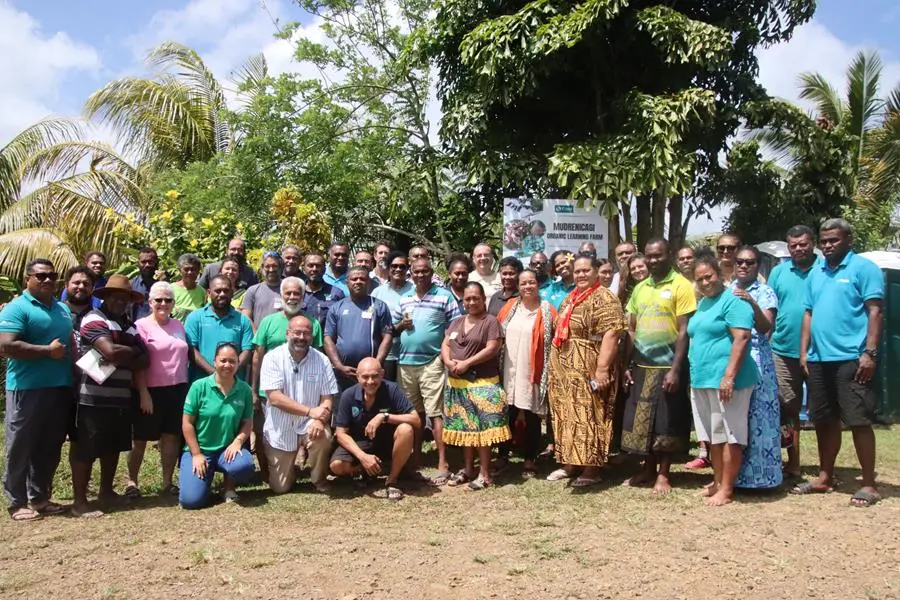
Practitioners from Solomon Islands and five other Pacific countries and territories joined a three-day learning exchange workshop at the Mudrenicagi Organic Learning Farm in Wainunu, Bua, Fiji.
The Capitalisation of Learning Exchange workshop was organised by the Pacific Organic Learning Farms Network (POLFN) project under the Pacific Community (SPC), and brought together people working in agriculture, forestry and conservation.
Participants came from Tonga, Solomon Islands, Samoa, the Federated States of Micronesia, French Polynesia, New Caledonia and Fiji. All the projects represented are supported by the Kiwa Initiative.
SPC said a main focus was how to use nature-based solutions in a way that lasts, and how to build them into everyday community practice so the benefits continue after project funding ends. Discussions centred on strengthening community ownership rather than relying only on outside support.
POLFN Project Manager Fuatino Fatiaki said the workshop aimed to bring practitioners from different sectors together to share experience and identify actions that could contribute to the United Nations Sustainable Development Goals by 2030.
The programme included farm observations, group discussions and practical activities, giving participants a chance to look at organic and agroecological farming methods and consider how those methods could be used in their own communities.
Mudrenicagi Organic Learning Farm Advisor Karen Mills said the Kiwa Initiative is about climate adaptation through nature-based solutions, and that the meeting was a rare chance for people doing similar work in different parts of the region to meet face to face. Some were working on forests, others on farming or oceans, she said, but all were addressing climate challenges in the Pacific.
The workshop also looked at market access and livelihoods, including how nature-based solutions could lift household incomes and strengthen local economies.
Yomalinda Pablo Alfons, representing the Conservation Society in the Federated States of Micronesia, said the exchange gave useful insight into the different situations and approaches in other places compared with home.
"We hope that the knowledge and experiences shared during this workshop will go beyond these three days and translate into meaningful actions within our communities," Fatiaki said, adding that participants should adapt what they learned to their local contexts.
The POLFN project sits under the Kiwa Initiative and is managed by the Pacific Organic and Ethical Trade Community at SPC. The Kiwa Initiative is funded by the European Union, Agence Francaise de Developpement, Global Affairs Canada, Australia's Department of Foreign Affairs and Trade and New Zealand's Ministry of Foreign Affairs and Trade.